top of page

One of the things I love most about the miniature world is that behind every great collection — and every great maker — there is always a deeper story.


When I sat down with Michael Reynolds for my latest of Meet the Miniaturist, I knew there would be history, artistry, and amazing objects in small scale. What I did not expect was just how much this conversation would reveal about legacy, family, and the emotional power of miniatures.


Michael’s journey began early — at just fifteen years old — when he built his mother her first dollhouse. That single act sparked something much bigger.


“For about four years, she and I heavily got into miniatures and began collecting.”

But like many artists, his path wasn’t linear. He went on to build a career in theater as a costume designer, stepping away from miniatures entirely.

“I walked away from it — lock, stock, and barrel.”

And yet, miniatures have a way of calling people back. After retiring from theater, it was his mother — still deeply immersed in collecting — who nudged him to return.

“She said, why don’t you try your hand at going back into miniatures?”

What followed was not a slow re-entry — it was a leap.


From Theater to Tiny Worlds

Michael’s background in theater didn’t just influence his work — it shaped it completely.

“I worked with incredible set designers, prop designers… it all translated. Just on a tiny scale.”

That idea — translation — is key to understanding Michael’s work. His miniatures are not simply small objects; they are staged, composed, and designed with the same visual storytelling sensibility you would find on stage. There is also something deeper at play.

Michael shared that as a child, he had once dreamed of becoming an architect, but severe dyslexia made the technical path difficult.

“I wanted to be an architect… but I could never handle the engineering math. But for some reason, I completely understood scale.”

Miniatures became the bridge — a place where creativity could override limitation.


The Work: Beyond the Dollhouse

Many collectors will remember the impact of Michael’s work on the show circuit — I certainly do. I still recall walking past his table years ago and being completely stopped by what I saw.

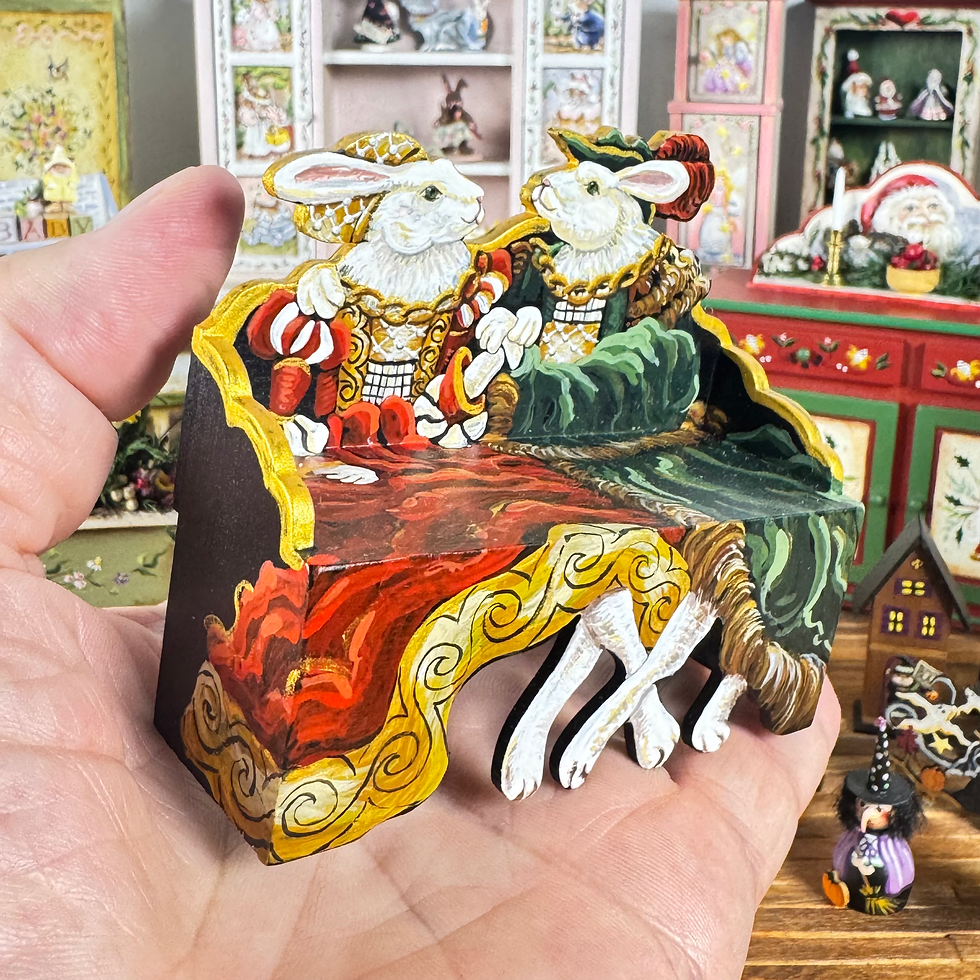
One of his most iconic creations — a dramatic dragon bed — has since taken on a life of its own.

“People equate that as my signature piece.”

The piece even crossed into unexpected territory.

“I had a woman message me and ask if it came in king size.”

That moment says everything. His work doesn’t just live in the miniature world — it breaks out of it. Over time, Michael intentionally pushed in that direction.

“I evolved into fantasy pieces and standalone pieces… something somebody could put with other artwork.”

This is where his work becomes especially important in the broader conversation around fine art miniatures — not as accessories to a dollhouse, but as complete artistic statements.


A Collector’s Legacy: His Mother’s World

At the heart of Michael’s story is his mother — a collector whose impact reaches far beyond her own home. Her collection, now in Michael’s care, represents over fifty years of deeply informed, instinct-driven collecting.

“She always treated her miniatures as works of art.”

And she lived that belief.

Rather than confining pieces to traditional settings, she displayed them throughout her home — in curios, on pedestals, integrated into daily life.

“She never really built room boxes… she exhibited the pieces as works of art.”

Her eye was extraordinary, and her timing even more so. She supported artists early — often before they became widely recognized.

“If she found someone she liked, she made absolutely sure she bought from them.”

That approach resulted in a collection that includes foundational names in fine art miniatures — from early pioneers to masters of silver, furniture, and decorative arts.

But what moved me most was not the scope of the collection — it was the meaning behind it. Michael shared a deeply personal story about one piece he plans to keep intact:


“What I love most about collectors is the story behind them… there’s always a backstory that rarely gets discussed.”

In that single statement, he captured something essential about this entire world.

Making, Collecting, and Creating Together

This was not just a story of inheritance — it was a story of collaboration.

Michael and his mother inspired each other constantly.

In one moment that perfectly illustrates this, she purchased an altar and crucifix at auction.

His response?

“That inspired me to actually build the chapel.”

That is the magic of miniatures — one object becomes the seed for an entire world.

His mother was also a maker herself, creating elaborate working chandeliers and lighting fixtures.


“She loved diamonds and shiny things.”

Many were sold, but many more remained — not because they weren’t good, but because she chose to keep them.

“If it didn’t sell, she never put it out again — she just collected them.”

As a result, Michael now holds not just a collection — but a hidden archive of her work.


Creating Without Compromise

When I asked Michael about his process, his answer was as honest as it was revealing.

“If I make something specifically to sell, it’s not remotely as creatively inspired as something that comes off the top of my head.”

That philosophy explains everything about his work.

It’s why his pieces feel unexpected, imaginative, and deeply personal — from fantasy furniture to painted miniatures to entire conceptual environments. Even now, his ideas continue to evolve.

“I’ve become obsessed with owls… I want to make ones where you pull a pin and their head spins.”

That sense of curiosity — of following an idea simply because it fascinates him — is exactly what keeps his work alive.


What Comes Next

At the moment, Michael is focused on completing a novel he has been working on for eight years — a creative pursuit that feels entirely in line with everything else he does.

But he is also returning.

“I’ll be back.”

And for those of us who remember the impact of his work — or are just discovering it now — that is something to look forward to. He is reconnecting with the community, revisiting shows, and exploring what comes next creatively.


Why This Story Matters

What stayed with me most after this conversation is not just the artistry — it’s the reminder of what this world really is. It is not just about objects. It is about memory.It is about storytelling.It is about connection — across time, across generations, across creative lives.

And perhaps most of all, it is about imagination. As Michael said so perfectly:

“Miniatures are where dreams become real.”

And conversations like this remind me exactly why I believe that too.

Remembering Lucy Ungerman Seiler

As I continue unpacking the collection of Lucy Ungerman Seiler, I find myself slowing down more than usual. There are estates that are large.There are estates that are valuable and then there are estates like this one—where, with each box opened, I begin to understand the person behind it.

Lucy’s collection is not just expansive—it’s expressive. It reflects a life built around curiosity, creativity, and connection. And the more I uncover, the more I realize that what I’m handling isn’t just a collection of dollhouse miniatures—it’s the record of a life fully lived in the miniature world.


To better understand that life, I spoke with fellow miniaturist Terry Unnold, who knew Lucy for many years. What she shared with me helped bring everything I’ve been seeing into focus.


“Lucy and I would go anywhere for a class”

When I asked Terry how she first met Lucy, her answer came quickly:

“I first met Lucy in our miniature club… Lucy and I would go anywhere for a class, anywhere for a workshop.”

That sentence alone tells you everything. Lucy wasn’t casually interested in miniatures—she was committed to them. She pursued knowledge, technique, and experience with real enthusiasm. Whether it meant traveling, signing up for a new workshop, or learning from a different instructor, Lucy showed up fully. And that spirit is visible everywhere in this estate.

I see it in the pieces she collected and commissioned .I see it in the materials and techniques that may have been used. I see it in the projects that she undertook —those that may have finished and unfinished—and parts and pieces and accessories waiting for their moment.

A house that brought people together

One of the things that struck me most in my conversation with Terry was how often Lucy opened her home to others.

“She shared her home to bring in artists like Bill Langford. That’s a wonder. Not everybody would do that.”

Lucy wasn’t just attending classes—she was helping create them. Hosting them. Supporting them. Her home became a place where miniaturists gathered, learned, experimented, and shared what they loved. Terry described rooms filled with materials, projects underway, and the excitement of new discoveries.

“She always had wonderful arrangements for us… lots and lots of materials to do the class… and then she’d show off everything we’d just gotten at shows.”

That generosity—of space, of time, of enthusiasm—is something you don’t always see. But once you know it, you start to recognize it in the collection itself.


“Everybody wants a little piece of Lucy”

At one point, Terry said something that has stayed with me ever since:

“Everybody wants a little piece of Lucy.”

I asked her why.

“Because she was such a wonderful miniaturist and such a generous person.”

That generosity shows up in more ways than one. Lucy supported artists.She took classes.She collected widely.She shared what she learned. And she didn’t just collect—she immersed herself.

“She was a wonderful student… she really learned and loved to learn techniques.”

A collector who followed her curiosity

As I work through this estate, one of the most striking things is the range. There are fine artisan miniatures.There are class pieces.There are whimsical and unexpected objects.There are multiples—evidence of deep dives into specific interests. Terry helped explain that, too:

“She was always interested in everything new… she never saw a class that she didn’t like.”

And when something captured her attention, she went all in.

“She fell in love with pottery… and immediately she would have to get a kiln and glazes and go on and on.”

That kind of creative energy is impossible to fake.And it’s impossible to miss when you’re standing in the middle of it.

An eye for detail—and a life of design

Lucy’s background as an interior designer shaped everything she did.


“She had a very good feel for color… if she changed something, it wasn’t obvious—it was a good change. She made pieces her own.”

That insight resonates deeply with what I’m seeing. There’s intention here.There’s editing.There’s vision. This isn’t just accumulation—it’s interpretation.


The emotional weight of a collection

There was a moment in my conversation with Terry that felt especially meaningful.

As she described going through Lucy’s things, as she helped her family organize her miniatures, she said:

“It’s been a little bit heartbreaking… I’m revisiting so many things we did together. So many classes we took together.”

That’s what collections hold. Not just objects—but memories. Not just purchases—but experiences. Not just things—but time. And as I continue unpacking Lucy’s collection, I feel that too. There are projects waiting.There are ideas midstream.There are stories still unfolding.


A legacy that continues

What gives me real comfort—and excitement—is knowing that Lucy’s influence doesn’t end here.

“Her legacy lives on. Oh, absolutely.”

Pieces are finding new homes. Materials are being shared. Knowledge is being passed along.And through this process, her collection is continuing to do what it always did:

Inspire. Connect. Encourage.

From Lucy’s world to yours

As I present pieces from the Lucy Ungerman Seiler collection in my upcoming auctions, I’m doing so with a deep appreciation for the life behind them. This is not just a sale.

It’s a continuation. A continuation of Lucy’s curiosity.Her generosity.Her love of miniatures.

And if Terry is right—and I believe she is—

“Everybody wants a little piece of Lucy.”

Now, perhaps, you can find yours!


Some collections are assembled. Others are lived into—slowly, lovingly, across decades of curiosity, making, and imagination. The story of Dorothy and her mother belongs to the latter.

Dorothy grew up in Massachusetts—in and around Boston—in a home shaped by a woman who was endlessly creative. Though not formally trained as an artist, her mother possessed a natural designer’s eye and a maker’s hands. She quilted. She sewed. She made clothing. And when her children were grown, she found a new, deeply absorbing passion: dollhouses and miniatures.

A Maker at Heart

Her mother built several full dollhouses over the years, likely starting with kits and then transforming them far beyond their origins through embellishment, interior planning, and thoughtful design. Among them were:


  • a white Federal-style house,

  • an upstairs–downstairs Georgian-style home,

  • a row house, and

  • the most ambitious of all: a grand house inspired by The Elms, one of Newport’s legendary Gilded Age estates.


This final house would become the centerpiece of her miniature legacy.

Inspiration Beyond Borders

Dorothy remembers her mother as someone who was always thinking, always planning. She traveled frequently—back and forth domestically and to England—absorbing architecture, interiors, and history. It’s very possible she was inspired by Queen Mary's Dolls' House, whose architectural rigor and extraordinary attention to detail set a high-water mark for what miniature worlds could be.

For her mother, miniatures became a form of interior design without limits. Every room was an opportunity. Every wall, furnishing, and object was considered. Dollhouses brought her immense joy—not as trophies, but as evolving creative spaces.


Growing Up Among Tiny Worlds

Dorothy and her sister grew up attending miniature shows with their mother, learning to recognize fine craftsmanship and the artists behind it. That exposure fostered a deep respect for miniaturists and an understanding that these tiny objects represent real skill, vision, and labor.

Dorothy herself also made 1:12 scale dolls dressed in period costumes, adding another layer to the family’s shared creative language. Though the family describes themselves as private and largely introverted, the miniature world offered a place of connection, expression, and quiet delight.


Inheritance, Memory, and Stewardship

When Dorothy’s mother passed away three years ago, Dorothy inherited four dollhouses. Today:

  • one lives in her office,

  • one occupies a converted guest room,

  • one resides in her husband’s office,

  • and one—the Elms-inspired house—is now ready for its next chapter.

Dorothy has chosen to keep three houses close, woven into daily life. The fourth, the most ambitious and architecturally commanding, will be offered in its entirety—a complete world—so it may continue to be loved, studied, and preserved.


Bringing The Elms to Market

I have the honor on behalf of D. Thomas Miniatures of bringing the Elms dollhouse to market. This is not simply a sale; it is an act of stewardship. Filled with tiny treasures accumulated over years of thoughtful collecting, the house reflects a woman who designed intuitively, planned obsessively, and created joyfully. It also reflects a daughter who understands the importance of honoring artists, craftsmanship, and the stories embedded in miniature spaces.

For enthusiasts, historians, and lovers of fine-scale work, The Elms represents a rare opportunity: to acquire not just a dollhouse, but a complete creative vision—rooted in family, inspired by great architecture, and shaped by a lifetime of making.


As I share this remarkable house with the miniature community, I do so with deep respect for the quiet, creative life that built it, and for Dorothy, who now carries that legacy forward. For purchase information, please contact me at 914-548-1984 and we talk more about how you acquire this lovely work!


# # #


Written and Edited by Darren Scala with the assistance of AI technology

bottom of page