top of page

Every once in a while, someone comes along who doesn’t just make miniatures — they live inside them. That’s exactly what I discovered when I had a chat with Andrew Sosenko (https://www.instagram.com/), a young furniture designer and artist whose work sits beautifully at the intersection of fine furniture, miniature architecture, and emotional storytelling. Andrew is part of a new generation of makers who instinctively understand what collectors of fine miniatures have always known: small worlds hold big meaning. Sosenko is currently exhibiting work at the MASA art gallery and jazz club in Latvia through February 18, 2026.

Andrew recently graduated from the University of Gothenburg in Sweden, where he earned a degree in wood-oriented furniture design, after previously studying product design and technology in Manchester, UK. He has since returned to Latvia, but his work is already circulating internationally among designers, collectors, and miniature enthusiasts who recognize something rare in what he builds. And what he builds isn’t just furniture.

It’s entire worlds in scale.

“I am obsessed with miniature.”

When I asked Andrew about his relationship with miniatures and dollhouses, he didn’t hesitate.

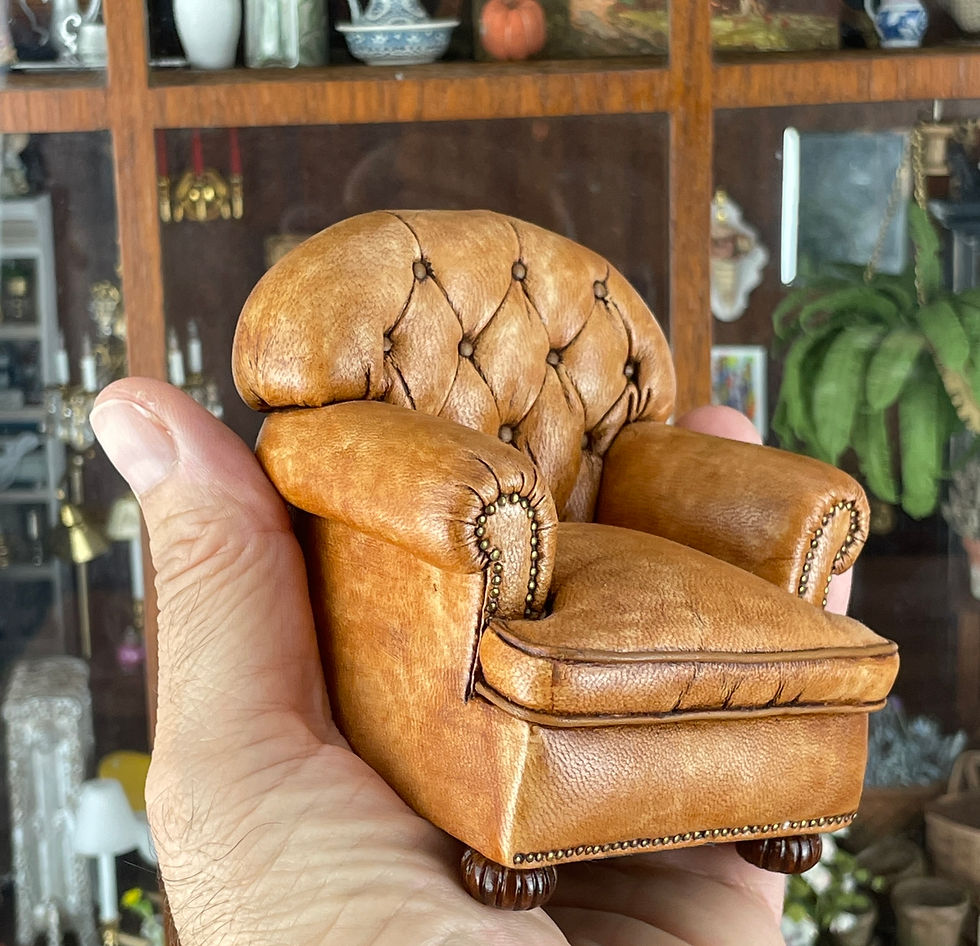
“I am obsessed with miniature! There is something fascinating about it. It gives me a sense of comfort and control… I can see the entire building in my eyesight and touch every element of it. I can hold a chair in a palm of my hand. Feeling like a god in a way.”

If that doesn’t sound like every serious dollhouse and miniature collector you’ve ever met, I don’t know what does. Andrew doesn’t see miniatures as novelty — he sees them as a complete universe you can touch.

“I could never build a house that I want in four days, but I can if it is smaller… I can build five of them and put them together so they form a flying city with inhabitants and stories… The most important thing? You can touch it and interact with it.”

That tactile, immersive, emotional relationship with scale is what puts Andrew squarely in the fine art miniature tradition — even when he’s building full-size furniture.

When Furniture Became a Dollhouse

Andrew’s breakthrough moment came when he finally stopped worrying about whether people would take him “seriously.”

“I was ashamed of making something more fun, thinking others would take me less seriously for making dollhouses… But one day I just said screw it… and people loved it. I was having fun and people around me had fun.”

That’s the magic point. When the artist lets go — the work becomes alive.

Today, Andrew designs fully functional cabinets, bookcases, and storage furniture that also operate as true dollhouses, built meticulously in 1:12, 1:24, and even 1:43 scale.

“I made cabinets and bookshelves… and even though they are meant as furniture pieces for clothing or books, all elements are made in 1:12 scale so it can be used as a dollhouse if a person wants to.”

In other words: you’re not just storing sweaters — you’re inhabiting a miniature city.

Furniture With a Soul

Andrew’s philosophy will feel instantly familiar to serious miniature collectors.

“I believe furniture can have a soul and personality… The objects we surround ourselves with can impact our mental well-being.”

This is exactly why fine-art miniatures matter. They are not décor — they are memory machines.

“My furniture provides stories, which modernist movement completely killed in design and architecture. Blank spaces have to exist… but a storytelling alternative has to exist too.”

That’s what separates Andrew from trend-driven design. He’s not chasing fashion — he’s building narrative.


Architecture, Wear, and the Poetry of Scale

One of the most compelling things about Andrew’s work is how deeply he uses architectural storytelling.

“I change not only styles but also how well the house element is kept — graffiti, wear and tear, abandoned or historically accurate… I even blend styles to create chaos.”

Anyone who has ever built or collected a serious dollhouse understands this: the wear is the story. Just like the finest artisan miniatures, Andrew’s furniture doesn’t feel manufactured — it feels lived in.


Built to Be Used

Here’s where Andrew truly stands apart. His pieces are not fragile sculpture. They are designed to be used.

“My pieces are fully functional and I get upset when people are afraid to use my furniture… I design and test it so it can take a lot of stress. Functionality is how I incorporate art in daily life.”

He builds primarily in wood, because of its emotional resonance:

“There is something about wood that feels like home, yet is still noble.”

That’s exactly how the greatest dollhouse furniture artisans think — wood isn’t just a material, it’s memory.

Sustainability, Scrap Wood, and Miniature Magic

Andrew’s philosophy is deeply aligned with the values of the fine miniature world.

“I avoid trends. The longer you keep the piece, the less you buy. That’s my idea of sustainability.”

Some of his most exciting work comes from reclaimed wood:

“Sometimes I make pieces completely from scrap bins… I glue them together, carve out elements and boom — a treasure piece made from trash.”

That is pure miniature alchemy.

Why Andrew Sosenko Matters to the Miniature World

Andrew doesn’t call himself a dollhouse artist. But in every way that counts, he is one.

He builds:


  • Narrative architecture

  • Scaled environments

  • Emotionally resonant objects

  • Worlds you can enter


That is the very heart of fine-art miniatures.

And perhaps most inspiring of all:

“Before I started furniture making, I had never held a saw in my hand… You never know what you are capable of until you just start doing things.”

That spirit is what keeps this hobby — and this art form — to exist to celebrate exactly this kind of maker: artists who don’t just make objects, but build entire universes in scale.

Andrew Sosenko is one of them — and I have no doubt the miniature world will be hearing much more from him!


###


Written with the help of AI technology/edited by Darren T. Scala


Most collectors and miniature enthusiasts are familiar with one legendary 17th-century Dutch dollhouse—Petronella Oortman’s spectacular cabinet dollhouse at the Rijksmuseum in Amsterdam. It is frequently cited as the pinnacle of Dutch Golden Age miniature art.


What far fewer people realize—even seasoned collectors—is that there are actually three extraordinary Dutch cabinet dollhouses, all associated with wealthy women named Petronella. Together, these works represent the highest expression of miniature artistry, domestic storytelling, and social identity in the 17th century.


Known today as “The Three Petronella Dollhouses,” these masterpieces are primarily housed in the Rijksmuseum in Amsterdam and the Centraal Museum in Utrecht. Each presents a slightly different vision of elite Dutch domestic life—and together they form the true foundation of what we now recognize as dollhouse miniatures, specifically: fine art dollhouse miniatures.


Why most people only know one Petronella dollhouse

The dominance of Petronella Oortman’s dollhouse in art history books, museum marketing, and even popular culture has unintentionally overshadowed the existence of the other two. Oortman’s house was famously so important that it was immortalized in a painting—an almost unheard-of honor for a miniature interior—and has become the shorthand reference whenever “Dutch Golden Age dollhouses” are mentioned. But Oortman was not alone.

Two other women—Petronella Dunois and Petronella de la Court—created dollhouses of comparable ambition, complexity, and refinement. When viewed together, these three houses reveal that this was not an isolated curiosity, but a recognized cultural phenomenon among elite Dutch women.


Dolls' House of Petronella Dunois (1650-1695), c. 1676. Rijksmuseum, Amsterdam, Holland. (Photo by: PHAS/Universal Images Group via Getty Images)

At a glance: the three Petronella dollhouses


  • Petronella Oortman’s Dollhouse — Rijksmuseum, Amsterdam

  • Petronella Dunois’ Dollhouse — Rijksmuseum, Amsterdam

  • Petronella de la Court’s Dollhouse — Centraal Museum, Utrecht


Each is a cabinet (pronk poppenhuis)—created to be admired, discussed, and used as a statement of taste, education, and control of the ideal household.


What all three Petronella dollhouses have in common

Despite their differences, the three houses share defining traits that link them unmistakably:


  • They were never children’s toys but elite display objects

  • Cabinet-style architecture, designed to be opened for guests

  • Meticulous, lifelike interiors: kitchens, nurseries, bedrooms, service rooms

  • A curated “ideal home”, revealing social values, wealth, and domestic order

  • Museum-quality miniature objects, often crafted from precious or authentic materials


These shared qualities are why modern collectors and museums view them as the earliest true fine art dollhouse miniature environments.


The one everyone knows: Petronella Oortman’s Dollhouse (Rijksmuseum)


Oortman’s dollhouse is the most famous—and for good reason.

It represents an idealized Dutch household, assembled with extraordinary precision and intention. Its cultural importance was so great that it was depicted in a contemporary painting, cementing its status as a work of art in its own time.

Notably, most of the original dolls are now lost, with the exception of a baby in a cradle—an important reminder that these were living collections, altered and handled over generations. The house also includes elements that quietly reveal the social realities of the era, making it as historically significant as it is visually stunning.


The overlooked counterpart: Petronella Dunois’ Dollhouse (Rijksmuseum)


Often overshadowed by Oortman’s fame, Petronella Dunois’ dollhouse is equally significant.

Dating to the late 17th century, it survives as a formally documented museum ensemble, with individual components catalogued as part of the house. Rather than existing as a single frozen moment, Dunois’ dollhouse reads as a structured collection of miniature works, emphasizing order, categorization, and domestic completeness.

For collectors, it feels strikingly modern: a carefully curated miniature environment assembled over time.


The connoisseur’s favorite: Petronella de la Court’s Dollhouse (Centraal Museum, Utrecht)

If Oortman is the household name, Petronella de la Court’s dollhouse is the deep-cut masterpiece that rewards close study. Housed at the Centraal Museum in Utrecht, it is expansive and richly compartmentalized, featuring rooms that span both public and private life—kitchens, nurseries, salons, gardens, laundry rooms, and servant spaces. It is not only a home, but a miniature portrait of daily life and labor.


Crucially, it also functioned as a miniature art collection, with objects commissioned and acquired over many years—exactly the behavior we recognize in serious collectors today.


Why recognizing all three Petronella dollhouses matters today

When we talk about the origins of fine art miniatures, focusing on just one Petronella oversimplifies the story.


Together, the three Petronella dollhouses demonstrate that:

  • This was a shared cultural practice, not a one-off marvel

  • Elite women used miniatures to express taste, intellect, and authority

  • The roots of today’s artisan miniature movement lie in curation, cohesion, and storytelling


At D. Thomas Fine Miniatures, these principles guide how we evaluate great collections—past and present. The Petronellas remind us that the most important miniatures are not just beautifully made, but thoughtfully assembled into worlds.


# # #


Written with the help if AI technology/edited by Darren T. Scala

Curators prep one of the extraordinary dollhouses at the Kaye Browning Museum in Maysville KY

It was a terrific year for miniatures! 2025 unfolded as a rich and rewarding tapestry of mini happenings and big moments filled with wonder, charm, craftsmanship, and excitement. From viral miniature sensations and museum-scale exhibitions to major collections entering the market, the world of fine art dollhouse miniatures continued its remarkable rise in visibility, relevance, and cultural impact.


I was thrilled over the past year to showcase my own collection of dollhouse miniatures in social media

Here are some of the biggest stories in the miniatures world from 2025, you may have missed that were posted on D. Thomas Miniatures social media and published in our newsletter. Be sure to sign up here so you never miss an update!:)


Minis2You featured in multiple online posts!

Focus on Mini Makers, Movers & Shakers

At the heart of every great year in miniatures are the artists including the makers whose vision, skill, and imagination help shape the direction of the hobby and the art form itself.


Gosia Suchodolska featured on Meet the Miniaturist in April 2025

Meet the Miniaturists: Podcast Highlights

The D. Thomas Miniatures Podcast Meet the Miniaturist continued to spotlight the creativity and ingenuity behind today’s miniature MINIssance.


Andrea Stark, from DeasDollhouses known for her extraordinary curated and commissioned miniatures shared her collection and creative journey in one of our most engaging episodes of the year.👉 Watch


  • Judith Keessen, based in the Netherlands, offered insight into refined European miniature traditions and enduring techniques by sharing her awesome dollhouse miniature mansion 👉 Watch

  • Marina Neff of Deck to Farm Charm brought warmth, authenticity, and new ways of thinking about miniatures to the conversation

Together, these makers exemplified why 2025 was such a powerful year for creativity in small scale.


Exhibitions That Defined the Year

Festival of Miniatures Launches in Brattleboro, Vermont

A big new mini new event debuted with the launch of the Festival of Miniatures in Brattleboro, VT which included shopping, activities and events highlighted by dollhouses, miniatures, model railroads and more in a community-wide effort to help celebrate the holiday season!


The Anonymouse Team Is Revealed

One of the year’s most intriguing cultural moments came when the mysterious Anonymouse Collective finally revealed their team and exhibited their work publicly in Stockholm. Long known for their tiny urban installations, this reveal marked a significant crossover between miniature art and contemporary cultural discourse.


Elizabeth Kirby’s Provincetown in Miniature

Artist Elizabeth Kirby captured widespread attention for her miniature structures inspired by the historic architecture of Provincetown on Cape Cod in Massachusetts. Her work was featured in The Provincetown Independent—beautifully translated sense of place, memory, and history into small scale.👉 Read


Dollhouse News That Made Headlines


Petronella Oortman’s Dollhouse Takes Center Stage

One of the most important dollhouses in the world, Petronella Oortman’s Dollhouse, moved into the spotlight at the Rijksmuseum and the exhibition included a virtual tour with never before seen close up view of the dollhouse narratived by Helena Bonham Carter. This show reaffirmed the role of this extraordinary work as both a historic artifact and a masterwork of decorative art. 👉Read


A Dollhouse Discovery in an English Castle

A remarkable discovery by Julie Montague, the America Countess, of a century-old dollhouse inside an English castle delighted historians and collectors alike, proving once again that important miniature treasures continue to surface in unexpected places. 👉 Watch


Tara’s Palace Finds a New Home in Ireland

One of the most heartwarming stories of 2025 was Tara’s Palace finding a new permanent home at The Little Museum in Dublin. Inspired by Georgian-style mansions in Ireland, Tara’s Palace measures more than 12 feet long, contains 25 rooms, and includes hundreds of miniatures capturing life in the 18th century.👉 Read


Jimmy Landers Unveils His Latest Masterpiece

Master craftsman Jimmy Landers once again raised the bar in fine art miniatures with the unveiling of Hawthorn Hill, a 1:12 scale reproduction of the home of the Orville Wright, of the Wright Brothers in Dayton, Ohio, reinforcing his place among today’s most accomplished dollhouse makers.


D. Thomas Miniatures: A Year of Education, Advocacy & Community


2025 was also a landmark year for D. Thomas Miniatures.

  • I was honored to present at the Guild Show hosted by the International Guild of Miniature Artisans and thrilled to be invited as the featured dinner speaker in Hasbrouck Heights, New Jersey. My talk explores the history of miniatures in culture and media, with a focus on the birth of the modern fine art miniatures movement in the 1970s and 1980s. I also hosted small talks about what defines a really great miniature at my table at the Westchester Dollhouse Miniature Show in White Plains, New York.

  • Additional highlights included docent training at the Hudson River Museum in Yonkers, New York, focusing on the extraordinary 24-room miniature mansion Nyblewyck Hall in the museum's permanent collection.

  • Finally, I held several online webinars about how to downsize your dollhouse miniature collection and how to build an awesome miniature collections.


Miniatures That Popped in Culture in 2025

Hollywood & Pop Culture Moments

  • A roombox inspired by an iconic scene from Demi Moore’s film The Substance was gifted directly to the actress, cementing miniatures’ presence in contemporary cinema. The effort was a collaboration between Kate Unver from The Daily Mini and artist Devin Drake. 👉See


Amy Sedaris charmed audiences by sharing her dollhouse tucked inside an unused fireplace in her Greenwich Village apartment. Featured in Curbed by Wendy Goodman, it was whimsical, personal, and unforgettable.👉 Read


Media & Programming Highlights

  • Laurence & Angela St. Leger, creators of exquisite tiny automata, were featured in the delightful short film The Odd of Small Things by filmmaker Mike Wallington.👉 Watch

  • Kaye Browning from the Kaye Browning Collection in Maysville, Kentucky, released a new book and participated in an engaging discussion on miniatures and storytelling on a special Meet the Miniaturist broadcast.👉 Watch

  • The BBC launched The Marvellous Miniature Workshop, bringing miniature artistry to a European audience. 👉More


  • Author Abby Ellin covered The Miniature Wars for Switchboard Magazine. and the mini drama surrounding the Kentucky State Fair 👉 Read

  • Town & Country delivered rare coverage of Queen Mary’s Dollhouse and included a behind-the-scenes look inside its dedicated room at Windsor Castle. 👉 Watch


Collections Brought to Market

The movement of major collections is always a defining marker of the year.

  • The Sharon Kay Zanassi Collection was thoughtfully brought to market, representing a lifetime of careful collecting and connoisseurship.👉 More

  • Bold, playful works—from Tiny Aranell to the provocative miniatures of Audrey Bagby reminded us that fine miniatures can be fancy, over-the-top, bitty, bawdy, and beautiful.


Looking Ahead

If 2025 proved anything, it’s that miniatures are not niche—they are vital. They live in museums and movies, in private collections and public imagination. They reward patience, honor craftsmanship, and remind us that the smallest details often carry the greatest meaning. At D. Thomas Miniatures, we are proud to document, celebrate, and guide this extraordinary world—honoring its past while helping shape its future.

Here’s to another year of small wonders making a very big impact!


###


Written with the assistance of AI technology and edited by Darren Scala


bottom of page